Archive for the ‘Courses’ Category
Friday, September 2nd, 2011

At first glance, Guitar Apprentice looks an awful lot like music interactive games such as Guitar Hero and Rock Band, but as the slogan for the software reads, “This ain’t no video game”.
Arriving this past Tuesday, August 30, Guitar Apprentice is an interactive learning program that allows beginner guitarists to learn the instrument while playing classic Rock ‘n Roll songs like “Shine”, “Sharp Dressed Man” and “Can’t Buy Me Love”. Following blockbuster results and rave reviews at this year’s Summer NAMM, Guitar Apprentice gives guitarists an entirely new approach to learning guitar. It combines the technology of video gaming and interactive player components with the use of your very own guitar, set to different skill levels.
Beginning players can now pick up their very own guitars and learn how to play, while engaging in an on-screen environment that supplies a fast, easy and fun instructional platform. The video system takes the guitar part of hit songs and breaks them into easy portions on multiple levels so that they are as painless and fun to learn as a video game.
On the lowest level, the player only plays a portion of the guitar part, while Guitar Apprentice plays the rest. The player gets to rock out with the entire song by playing only a few chords. As the player improves he moves up through the different levels playing gradually and increasing portions of the guitar part. By the time the player reaches the highest level, he is playing the entire song and ready for the stage!
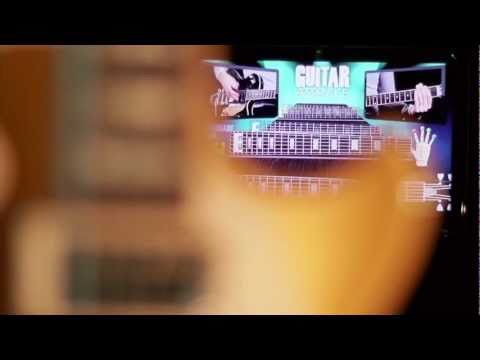
At GuitarApprentice.com, consumers may download the free trial song of the week or subscribe to the entire catalog. New songs are added weekly and already includes hits like “Boom,” “Hit Me With Your Best Shot,” “Shine,” “You Really Got Me,” “Sharp Dressed Man,” “Taking Care of Business,” “Get Back,” “Hey Jude,” “Can’t Buy Me Love,” “Independence Day,” “Please Remember Me” and “Mountain Music.” Can’t read music? The on-screen display is easy to decipher regardless of your knowledge of sheet music.
While video games like Guitar Hero and Rock Band can be fun, the reality is that these simple music interactive games cannot captivate the “real thing” and toy plastic guitars will never allow you to reach your dream of being a rockstar. Meanwhile, Guitar Apprentice has that potential. The younger generations obviously enjoy games like Guitar Hero so why not transform that into an experience where you learn in a similar environment with an actual guitar?
We think it’s a genius concept and if you are looking for a refreshing way to learn guitar (while playing some of the biggest hits in the industry) you need to check out Guitar Apprentice. Get all the information at GuitarApprentice.com.
Posted in Courses, Guitar, Learn Guitar Online, Videos | No Comments »
Sunday, August 21st, 2011

Rhythm guitar is a technique and role that performs a combination of two functions:
- To provide all or part of the rhythmic pulse in conjunction with singers or other instruments
- To provide all or part of the harmony
As a result, rhythm guitar traditionally requires the guitarist to hold down a series of chords with the fretting hand while strumming rhythmically with the other hand. While everybody likes to play lead guitar, most bands need at least one rhythm guitarist (often more) and mastering rhythm guitar is easier than mastering lead guitar therefore allowing you to get into performing sooner. Also, if you want to sing and play guitar you will more than likely play rhythm guitar while singing.
In order to learn to play rhythm guitar you must understand these basic concepts:
- Power Chords
- Straight 5ths
- Drop D Tuning
- Drop C Tuning
- Palm Muting
- Traditional Barre Chords

Power Chords
Power chords, like the name implies, provide a lot of energy for modern day music. The good news about power chords (also called “fifth chords) is they are very easy to play because the structure of the chord only requires the root of the chord and the fifth interval. Power chords are usually played on the electric guitar with distortion. They are a very popular element of rock music.
Straight 5ths
Straight 5ths represent a less common, but nonetheless useful power chord in your quest to master rhythm guitar. Straight 5ths is essentially playing two strings on the same fret. As a result, the straight 5th provides the rhythm guitar with a more “deathly” sound.
Drop D Tuning
Some guitarists tune their E string down to D so that they can play power chords. Believe it or not but Drop D tuning has been used from Van Halen to Led Zeppelin and provides a deeper, darker sound. Thus, it’s very popular with metal bands.
Drop C Tuning
Even heavier than Drop D tuning, Drop C tuning is a notorious rhythm guitar technique for metalcore bands such as Killswitch Engage and As I Lay Dying. Drop C tuning requires you to not only tune the lowest string to C, but all other strings down one note as well.
Palm Muting
Palm muting is another technique used often in metal. Any song that features an endless stream of grinding, chunky rhythm notes between the chords is what you would define as palm muting. Learn more about pulling off palm muting HERE!
Traditional Barre Chords
Traditional barre chords is a type of guitar chord, where one or more fingers are used to press down multiple strings across the guitar fingerboard (like a bar pressing down the strings), enabling the guitarist to play a chord not restricted by the tones of the guitar’s open strings. Barre chords are also referred to as “moveable” chords.
Posted in Courses, Guitar, Learn Guitar Online, Videos | No Comments »
Tuesday, August 2nd, 2011

In the past, GLC has examined how the abundance of free information on the World Wide Web can transform any disciplined, self-motivated individual into the next guitar legend. Furthermore, GLC has reviewed some of the top self-taught guitar courses for further guidance. During our quest to find the best guitar courses we have also run into some other fantastic guitar websites as well as some really poorly design sites with misleading information and/or overpriced lessons.
As a result, we wanted to spend today examining a very good website — RhythmStrummer.com. In fact, we have 7 reasons why you need to check out the website.
Authentic Lessons
A lot of websites promote easy guitar lessons yet the quality is not always the same. Thanks to a well educated, diverse staff — Rhythm Strummer lessons are clear, effective, detailed and easy to understand. Most importantly, the versions of the songs they are teaching are remarkably accurate which any guitarist surfing the Web can attest — that’s not always the case.
Diverse Lesson Selection
Rhythm Strummer features acoustic guitar lessons and techniques in several different genres. Lessons are divided into two categories: Easy Guitar Lessons and Easy Guitar Techniques. Combined the two categories offer hundreds of lessons and the catalog is constantly growing!
Fair Pricing
Yes, RhythmStrummer.com does charge a monthly fee (unless you stick with the limited free lessons). An individual guitar lesson on Rhythm Strummer costs $4.99, while an Easy Guitar Technique will cost you $14.99. Of course, you can also invest in the full membership (best deal, $24.99) featuring Unlimited Viewings per Video, 30 Days of Full Access to Technique Library, 3 Song Lessons for 30 Days and Access to Song Lesson Specials.
RhythmStrummer.com also supports the arts by paying the musicians whom are featured on the website.
Learn Guitar…and Sing Along
Unlike most guitar lessons, RhythmStrummer.com also teaches viewers how to sing along while they play a song. You might not want to be the next Mick Jagger yet learning to sing and play guitar at the same time is an important asset. A lot of bands need backup singers to harmonize, etc.
Fantastic Teachers
The staff at Rhythm Strummer features professional teachers and performers, each with a unique personality. Your average lesson on YouTube traditionally fails in this department as the instructors lack spunk, do not communicate certain concepts effectively, etc. However, the instructors at RhythStrummer.com are all exceptional at what they do — teaching the guitar.
Cool Features
Rhythm Strummer offers some unique guitar lesson features like innovative Strum Patterns, Chord Charts and Chord Diagrams. Learn more about these features HERE!
Free Stuff
In addition to lessons and techniques that cost money, RhythmStrummer.com offers further value by providing a limited catalog of Easy Guitar Songs, Free Techniques and Song Promo Options.
—
Interested? Learn more about the site at RhythmStrummer.com.
Posted in Courses, Learn Guitar Online | No Comments »
Thursday, July 28th, 2011

The term arpeggio (ar-peg-ee-oh) may look and sound like a foreign language yet arpeggios actually belong to one, universal language — music. Simply put, arpeggios are a reason that regardless of race, color, social class, etc we all have a common connection with music. Consequently, understanding arpeggios (and incorporating them into your learning experience) will make you that much better of a guitarist.
Arpeggios represent a challenge for some beginner guitarists. Fortunately, the guitar skill is very easy to understand, discover in popular music and therefore implement into your own practice routine. If you do struggle with arpeggios at first do not get frustrated. Stick with the basics outlined (below) and you’ll improve over time.
Before you can master arpeggios you must first understand arpeggios.
Cue the Music Theory:
Arpeggios are what some experts define as “broken down” chords. In order to understand a “broken down” chord you first must have a solid background with not only chords but chord structure. If you are clueless about the four basic triads of chord construction you need to take a step back and work on your theory before attempting arpeggios.
When you play an arpeggio you are NOT strumming the chord. Rather, you are playing every single note in a specific chord SEPERATELY. Make sense?
Example: C Major Chord is composed of the notes C, E, G (or first, third and fifth note of the major scale). Instead of playing C, E, G together for the chord you play each note individually in a sequence.
The four major triads are:
- Major (1st, 3rd, 5th)
- Minor (1st, b3, 5th)
- Augmented (1st, 3rd, #5)
- Diminished (1st, b3, b5)
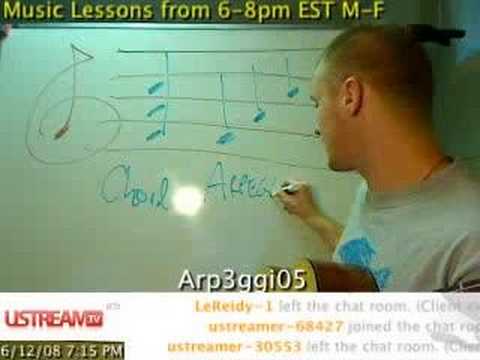
If you have a decent understanding of scales, chords and triads then you know that triads are the notes that traditionally “stand out” in a given scale. Once you know the scale and you know the notes that compose a triad of that scale you will finally become aware of just how powerful arpeggios can impact a song.
If you want to use the above C Major example then you know that the notes C, E, G create the triad. With that knowledge you can literally create hundreds of different patterns utilizing only those three notes. Pretty cool, eh?
One of the first steps to mastering arpeggios is really getting down the music theory. If you have done your homework, you know that the Major scale produces a happy vibe while the Minor Scale is sad. What does the Augmented scale produce? If you said something like “exotic” you’re on the right track.
Arpeggios add a whole new arsenal of options to your guitar playing. Do your homework on music theory, learn about finding the different scales on the guitar neck and begin working on those arpeggios!
Posted in Courses, Fingerstyle, Genre, Guitar | No Comments »
Wednesday, April 20th, 2011
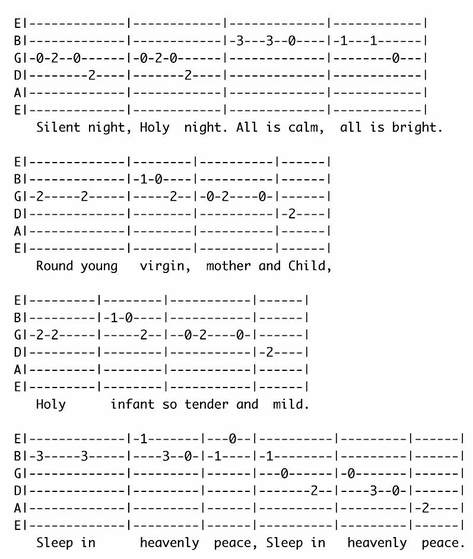
Guitar tabs have substantially progressed the learning curve that one needs to understand and learn to play their favorite popular tunes. Although most will associate the popularity (and thus its origins) of guitar tabs with the boom of the Internet, music tablature actually dates back as far as the Renaissance.
Tabs are a fantastic way of deciphering musical notation without needing the ability to read sheet music, because it can take a popular song, like Led Zeppelin’s “Stairway to Heaven”, and inform the guitarist on what strings they need to strum and where they need to fret. As a result of the simplified “sheet music”, guitar tabs are the easiest way to learn a new song.
Unfortunately, guitar tabs are user-submitted and thus the accuracy of each tab should be questioned. Frankly, there are a lot of poorly composed guitar tabs that are not even remotely accurate. Therefore, by paying special attention to the site (best websites for guitar tabs listed below) as well as rating of each tab will clue you in as to the legitimacy of the guitar tab.
Ultimate-Guitar.com
Ultimate-Guitar.com prides itself on being the “#1 source for guitar tabs, bass tabs chords and guitar pro tabs”. With over 300,000 guitar tabs and counting, Ultimate Guitar is one of your best (and biggest) resources for useful guitar tablature.
It’s a pretty easy website for searching and finding the particular song or artist you need. In addition to the guitar tab database, Ultimate-Guitar is also a terrific site for all things music as they post a lot of great articles and interviews. They even have a few useful guitar lessons.
A basic search of even a remote band like Primus will bring up 420+ results so it’s easy with the several different “versions” of each song to get overwhelmed. Consequently, it is important to pay special attention to the guitar tab’s rating and number of comments. Readers can rate the accuracy of the guitar tab as well as comment with revisions, so this is your best option for quickly finding out the accuracy of the tab.
Songsterr.com
Songsterr does a really nice job of organizing their guitar tabs as you’ll immediately find their database sorted by difficulty level on the homepage. For example, Pink Floyd’s “Comfortably Numb” might be a brilliant song, but it’s also extremely difficult to learn on the guitar. Thanks to Songsterr, you’ll quickly notice that the tab is classified under “Advance” while equally great jams like Linkin Park’s “Numb” and Bob Marley’s “Redemption Song” fall under “Beginner” and are much more suited for beginner guitarists.
Users can also sort guitar tabs by the genre and even decade of release. Upon reaching a specific guitar tab, you will notice that like Ultimate Guitar, you not only have the ability to listen to the actual song, but also change up the mix (i.e. eliminate vocals), speed and more. Unfortunately, not all of these features are available for free so check out their rate plans if interested.
Like a lot of the top rated guitar tab websites, Songsterr is also available on the iPhone so it’s really great for mobile users.
Guitar World Tabs
Similar to Ultimate-Guitar, Guitar World Tabs has a lot of amazing feature stories and interviews on the website. They’re not just a guitar tab resource. The site is very well designed with a plethora of information and if you’re still not satisfied, Guitar World even puts out their own monthly newsletter that you can sign up to receive for free!
The search function on the site is really easy to use as visitors can sort for basic things (guitar vs. bass), and even view the top-rated, most viewed and/or recently added guitar tabs with a click of the mouse.
What’s really innovative about the specific guitar tab page is that the screen will auto-scroll (at a very slow pace) so you do not have to pause every few seconds, take your hands off the guitar and manually scroll down to read the next part of the verse or chorus.
—
You should be able to find just about any guitar tab on one of the websites listed above. We should note, however, that even though we consider Ultimate-Guitar, Songsterr and Guitar World Tabs the three best resources for guitar tabs even the top sites have a lot of poorly composed tabs. By paying special attention to the tablature’s rating, comments, author history (does he or she post a lot? good overall rating?), comparing to other tabs (same song) you will vastly enhance your chance of learning from a legitimate guitar tab.
Posted in Courses, Guitar | No Comments »
Monday, December 13th, 2010

If you’ve been watching television of late you can probably testify to the abundance of Christmas ads. And if you’re someone who takes pride in being up-to-date on the latest electronic products you can also probably testify to easily one of the hottest gifts of Christmas 2010 — the Apple iPad.
I know my favorite iPad commercial is the one in which Apple quickly highlights many of the iPad’s incredible features including (drum roll please) the ability to hook up your electric guitar and use the small device as an amp!
Pretty cool, right?
What’s also great about any Apple product is the ability to download apps, many of which are free. So in celebration of the new iPad and that guitar amp feature, we thought ’tis the season to highlight some of the best guitar apps on the market.
Check it out…
ChordBank for Guitar
Everyone likes stuff that’s free. Consequently, ChordBank is awesome because you get access to over 1,300 guitar chords for the price of nothing. That’s zilch, zip, nada. Strum to hear any chord played out loud or pluck individual strings to pick out individual notes. It’s all there with 22 complete fingerings.
Free!
Gibson Learn & Master Guitar
You may recognize Learn & Master Guitar, one of GLC’s top five rated guitar courses available. You may also recognize Gibson guitars, arguably the most famous guitar manufacture in the world. Together? They form quite a potent combination — the Gibson Learn & Master Guitar.
This application provides you with essential tools to help you become a better guitar player as well as free full length lessons from the award winning Learn & Master Guitar.
Free!
PocketGuitar
Don’t own a guitar?
PocketGuitar is a good place to start. It will transform your iPhone or iPod touch into a virtual guitar. Users can press and strum strings and when they get tired of being the next Slash, of course you can always jam out with the electric bass or ukulele. PocketGuitar also has some really sweet distortion effects as well.
$0.99
Fret Surfer Guitar Trainer
The Fret Surfer Guitar Trainer is seriously worth noting (no pun intended). For the price of $3 (less than a bottle of water these days), owners can learn every…single…note on the guitar. It’s a great resource with tons of customizable features.
$2.99
GuitarToolKit
GuitarToolKit features both a stellar reputation (very highly rated on iTunes) and loads of killer guitar utilities. The tuner is amazingly accurate and you also get a library of over 500,000 chords.
$9.99
Do you agree with our list? If not, what fantastic apps can you add?
Posted in Chords, Courses, Guitar, Tuning | 1 Comment »
Wednesday, November 10th, 2010
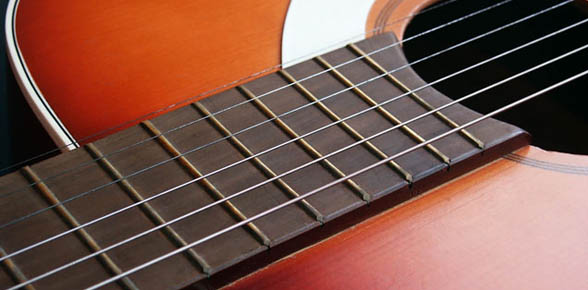
Today we’re going to take a look at guitar bends, something that you could classify as an “moderate to advanced guitar technique”. What are the bends? Simply, the guitar bend is designed to give what some guitarists simply refer to as the “voice”. Think about it this way: You can play the note but what happens when you play that same note and also put a twist on it? That twist is what we define as a change in the pitch.
Depending on your skill level, either guitar bends have become something that is simply second nature or rather a particular skill you’ve always wanted to master but afraid it could be too difficult. Truthfully, bends are not exactly extraordinary complicated but they will give you a lot of trouble in the early stages.
As I already mentioned, guitar bends is all about changing the pitch in the note. While this may sound relatively easily it does take some practice and focus to make it work right. Which is what we’re all after, right?
Guitar bends are executed by using not one, not two, but three fingers. This is accomplished by placing your third finger on the fret you are trying to bend while placing your first and second fingers on the frets behind it. Exert pressure with all three fingers and ah-la — you got a bend.

So, for example, you could fret the note on the eight fret, third string with your third finger. Then, you would place your second finger on the third string seventh fret and your first finger on the third string, sixth fret.
Got it?
Your ultimate goal is to bend the note up one semi-tone – or what guitarists refer to as a “half step” – and then return the note to its original pitch. You do this by picking the note you want to bend, pressing (in an upward motion or toward you) while still putting some pressure on the strings. A common mistake is to only want to bend the note with your primary finger (in this case, the third finger) while the other two remain still. However, a wise guitarist will use all three fingers. After you have accomplished the bend desired, return the note to its original pitch.
If the first time you practice a guitar bend the pitch does not seem to alter much, fret not. Guitar bends do take practice and you will not master them at first. Acoustic guitarists, beware, I hate to break the news but guitar bends are even a little tougher on acoustic.
Remember when you first started playing the guitar and your fingers ached for like two weeks? That’s how you have to approach the bends. You’re likely using finger muscles you’ve never used before and they will take time to develop. Hey, Hogan did not become the Hulk overnight either.
Patience truly is a virtue.
Note: Once you master the “half-step” bend try a “full-step” bend which requires that you bend the note up TWO frets.
Posted in Courses, Guitar, Learn Guitar Online, Videos | No Comments »
Sunday, October 31st, 2010

Happy Halloween!
In celebration of the holiday, GLC wanted to examine some absolutely HORROR-iffic bad guitar habits that will transform your potential to be the next Jimmy Page into nothing more than a Guitar Hero high scorer.
FADE IN:
LITTLE JIMMY practices his guitar. The instrument is beautiful. Something that has been preserved with great care, beautiful, if you could smell it you would still catch a sniff of that “brand new” smell.
However, there is something wrong. Little Jimmy is playing the instrument with his left hand (the one that presses down on the strings) with a thumb that rests high on the back of the guitar neck. Everyone should know that poor thumb positioning hinders hand and finger mobility. Perhaps this is a horror story after all.
BAD HABIT #1: Watch that thumb positioning on the left hand. The thumb should be positioned low on the back of the neck in order to maximize finger mobility.
INT — BEDROOM – NIGHT
Little Jimmy surfs the Web for a helpful guitar tab that will show him how to play the song “Scar Tissue” by the Red Hot Chili Peppers.
He loves the song and has always wanted to play. Little did he know, focusing too much on guitar tabs and learning to play sections of your favorite songs will only create a monster.
BAD HABIT #2: While guitar tabs are a very sweet alternative to learning sheet music, too many novice guitarists turn to tabs too quickly. Rather, learn the fundamentals and basics FIRST and then slowly progress to that Lynard Skynard “Free Bird” solo.
EXT – PARK – DAY
Little Jimmy is outside, enjoying the wonderful day with his girlfriend. He has not picked up the guitar in a few days but hey, creativity arrives in stretches. There is always tomorrow, right?
BAD HABIT #3: If you realistically want to become a “guitarist” you must practice every day. No, you do not need to put in several hours but a consistent and regular schedule will ONLY ensure progression. Without it, you’ll never become a skilled musician. Try 15 to 30 minutes a day.
INT – BEDROOM – NIGHT
Little Jimmy’s girlfriend broke up with the future rock star. Now, he has nothing better to do than practice guitar. That, and prove his ex wrong once he finally makes it.
The only problem is his posture is absolutely horrendous. Dismissing any common sense, Little Jimmy wants to play the guitar with the neck facing down (to change the “culture”), ignores the guitar strap, does not sit up straight and refuses to cut his fingernails.
BAD HABBIT #4: Oh, so simple. Correct posture is required for beginner guitarists just as much as it’s required in a business class. The guitar is your business and you must treat it right. Sit up straight, cut your nails, hold the pick right and for God-sakes – point the guitar UP when playing.
EXT – BURGER KING – DAY
Our story has come to an unfortunate conclusion. Little Jimmy tried to learn the guitar with one too many bad habits. Some say that the tragedy of it all is that Little Jimmy could have become an accomplished musician had he spent a little more time here, a little more time there.
Regardless it was out of tune and ended on a sour note. Little Jimmy’s future was destine for a Manager at Burger King.
BAD HABBIT #5: While the simplest of them all; playing the guitar out-of-tune is a train wreck waiting to happen. Music is all about precision and hitting the right note, at the right time. How can you possibly achieve that feat when your guitar is out of tune? Fess up the money for a solid guitar tuner and tune that puppy EVERY time you play. What are you lazy!?
Posted in Courses, Guitar, Tuning | 1 Comment »
Thursday, October 7th, 2010

So you’ve made the plunge. You’ve opted to learn the guitar through a self-taught lesson rather than pay for private lessons with a personal instructor. You’re more than likely a self-motivated, driven individual but more than anything really enthusiastic about learning the guitar.
Congratulations! You’re perfect for the job.
Throughout the next weeks and months, your assignment, if you choose to accept, will be to learn and master everything you can about the guitar. But you cannot do that until you pick the course that is perfect for you. What is the perfect guitar lesson course you may ask? Unfortunately, it’s not that simple. To each his or her own.
So let’s look into five common yet very important features of a “good” guitar course. When researching and comparing courses you’ll likely find three to four really solid lessons but you’ll be divided between which one is the best. These five important guitar course features may convince you of the product that is just right.
#1 Quality of Lessons
When shopping for guitar courses, always note the quality over quantity approach. Sure, one course may advertise 300 guitar lessons but how many of those lessons are actually teaching valuable information and exactly how long are those lessons. I don’t know about you, but I would take 50, quality, 20+ minute lessons over 300, dry, 2 minute lessons. It’s all about the quality. How do you get good quality with online guitar lessons? That’s a great question…
#2 Teaching Style
It’s not exactly about who is teaching when it comes to online guitar lessons, but rather how many people are teaching and of course…what’s their background. Arguably one of the greatest features of self-taught lessons through book and DVD is that you can get multiple different opinions from multiple teachers. You may have a particular name in mind. However, you’re much more likely to not know a name yet seek a particular style. Do you enjoy, lively, energetic teachers or straight-to-the-point, step-by-step educators? Always consider the style of the teacher.
#3 Support
This feature is often overlooked so make sure you’re aware of its importance. In the last feature we examined one of the strongest selling points of online guitar lessons — the availability of multiple teachers on one course. Now let’s look at a major drawback — a lack of support. No personal instructor means NO personal instructor. You’re going to get confused, lost and have a question or two from time to time. Invest in a product that has features like 24/7 chat, phone, forum or any other way you can either connect with an expert or fellow guitarists. You need these people during your early struggles learning the guitar.
#4 Additional Features
We define “additional features” as anything that goes above and beyond the basic tools and resources needed to learn the guitar. For example, have you ever considered how important a metronome is and how few online guitar courses actually provide one with the program? Wouldn’t it also be nice to have a variety of different backing tracks once you become a little more advanced and want to strum along with a tune? Again, some have them…some do not. Write down five things you would really like as extras to your guitar learning experience and your goal is to try and find one program that offers them all. Deal?
#5 Value
Ah, the good ole’ C.R.E.A.M. rule. Price does rule everything around you and selecting the best guitar lesson is clearly no different. The key term here is value. You do not want a product that is too expensive, because, after all we all have budgets. Some guitar lessons out there are simply way too over-priced. On the contrary, avoid those ridiculous “bargain deals”. As always, common sense is advised. Find something that is a nice, “happy medium”.
In short, the basics to learning the guitar have not changed. However, some programs (just like educators) are better than other programs (or fellow educators). If you’re going to spend money on a course that will teach you the guitar why waste it on something that is not appropriate to your individual needs and/or learning style?
Consider the five most important online guitar lesson features, research convulsively and consider wisely. Oh yeah, and we also broke down what we found to be the five best guitar lessons utilizing this same criteria. Enjoy!
Posted in Courses, Guitar, Learn Guitar Online | No Comments »
Thursday, July 15th, 2010
“Many will enter, few will survive.”
The above quote may be more appropriate for a gladiator movie, yet it’s also in a strange way fitting of the process in which you attempt to learn to play the guitar.
Think about it. The guitar is not too physically demanding but what it lacks in real, tangible stress it makes up for in mental frustration. Learning a musical instrument is not easy and by now I’m sure you have heard that a thousand different times.
That’s not the point of this post. The point of this post is to examine the many ways in which it is possible to learn to play the guitar without the aide of an instructor.
Personal instructors are time consuming, demanding, and more than anything expensive. And I’m here to tell you that you don’t need them. In fact, I’m here to tell you that you can do better (gasp) on your own. I’m here to tell you that learning the guitar has never been so easy to pick-up as it is in the 21st century.
So, where do you begin? Self-taught guitarists would tell you that it is definitely possible to self teach guitar based on their experience. These people are also highly dedicated, organized, and determined to their craft – playing the electric or acoustic guitar.
However, not everyone is as dedicated, organized, and determined as those same individuals. In fact, most struggle to remain self-motivated, especially when they are picking up the guitar at an older age when school, work, family, etc seem to always take precedence.
Consequently, in theory, it’s not that hard to learn the guitar but it is hard to stay committed. If you’re a real human like the rest of us, chances are that getting an education or making a living is going to have to take priority over being a rockstar…for now anyways.
- Dedication, Organization, Determination -
Get it, Got it? Good.
If you really think that the guitar is self-taught than you must possess all three traits. Then, you need to look into the three most important, yet overlooked tips.
1. Structure Your Lessons
The most common mistake is to pick up short tutorials from various sources such as guitar books, websites, or magazines and fail to structure everything together. The problem with studying various and seemingly unconnected tutorials is that they share no relation, so beginners are unable to make sense of the standard guitar concepts.
The result is the revelation that you’re not progressing but merely picking up a variety of otherwise useful lessons scattered in an inconceivable order. Hence, the individual losses passion for the instrument, failing to develop a strong foundation in proper techniques needed to progress.
Structured guitar lessons should progress in challenge and complexity. You should start with the sheer basics, such as posture, hand position, holding of the pick, tuning, etc. Slowly you should evolve into basic chords, scales, rhythm, and strumming patterns. The lessons are sequential.
Get it, Got It? Good.
2. Learning Plan
Now that you have structured lessons, the guitarist must institute a lesson plan. When will you play and for how long? This should be a strict time each day that is consistent. It’s not good enough to just assume you’ll practice when you “have a minute.” Daily practice is necessary, so you cannot merely think it’s a once or twice a week type of activity.
3. Self-Discipline
A wise man once asked, “I have the foundation and the tools, what else do I really need?” Exactly. The structured lessons will serve as your foundation while the lesson plans will work as your material and tools. With this solid foundation, material, and tools, the guitarist truly does not have a reasonable excuse for failing.
Remember, it all goes back to dedication, organization, and determination. Everything is outlined for you, now it’s time to put your intentions into action.
Now, laying out the three basic (but often) overlooked tips may seem easy enough, but if you are a logical person you can probably cite something that is even wrong with this plan.
Knowledge.
The bottom line is that you can be the most stubborn, organized, and driven aspiring guitarist of all-time, but if you lack the knowledge of the instrument you are destine to fail. That is where personal instructors came in for decades and where the Web is slowly replacing them. Someone or something must be your source for reference because after all, if you already had all the information, knowledge, insights, and wisdom on the guitar, you probably wouldn’t be classified as a “beginner” now would you?
Here is where online, self-taught guitar lessons come into the equation. They are one part personal instructor (often taught by expert in the industry who lives far, far from you) and another part self-driven. So you are essentially learning to play the guitar alone, but with the advice, tips, and lesson plans from one of the greatest guitarists in the world.
Not bad when you think about it.
In fact, GLC has dedicated its entire online existence into providing you with the very best online guitar courses in the world. Suddenly, $19.95 for JamPlay or even $149 for Learn & Master Guitar doesn’t sound so bad.
Click Here! For our full, detailed reviews on the top four programs.
Here is my challenge. I dare you to skip the costly needs of a personal instructor and to otherwise use that monetary investment on an online guitar course. Often you can download or order these programs via mail, go through the lessons at your pace, and learn as much if not more from these highly skilled and knowledgeable teachers.
Playing the guitar without an instructor…it’s as simple as that.
Posted in Courses, Guitar, Learn Guitar Online | No Comments »
|