Archive for the ‘Blues’ Category
Wednesday, November 17th, 2010

So you’ve been playing the guitar for quite some time now. You’ve developed a nice practice habit, absorbed all the information possible and even joined a band. Where do you go from here? You play your first gig, of course.
I’m guessing that what motivated you to get into playing the guitar in the first place was eventually to perform. Do not get me wrong, practicing in your lonely old room is fun and all but the true joy of music comes from playing it in front of others. However, your first gig is going to be a little nerve-racking and more than anything NOT perfect.
Which means do not set your standards low (always shoot for the best) but after the gig is all said and done realize that you made mistakes and the beauty is that you can learn and improve on those mistakes. So what’s The Guitarist Survival Guide to acing the first gig?
I like to divide this guide into five separate steps…
Anticipation
This is the entire build up to your very first show. I’m talking about both the personal practice needed to hold your own in the band as well as the business side of actually booking that first show. You should obviously know the songs by heart and be familiar with the set-list prior to the gig. However, for an artist approaching the business side it may not be so easy. Remember to start with something small. This is your first show after all and it’s going to take some time to make your act known. Do not be afraid to play in a little venue and if all else fails, playing for free is not the worst thing in the world. Just do not make it a habit — you’re a respectable guitarist in a respectable band.
Gear Prep
If you’re nervous, it’s easy to overlook the gear prep. Big mistake! You must know your gear in and out, from what guitar works best for which songs to amp and effect settings. Double check that your strings are in good condition and that you have plenty of extra picks, string, cable, etc. Even little things like an extra set of batteries for your FX are important. Remember, nothing screams amateur more than a band that is not properly equipped.
The Arrival
You may idolize rock stars who did not play by the rules but for God sakes be respectful and BE EARLY. You’re not Led Zeppelin and the world does not revolve around your music. Those bands may have been able to get away with murder and unreasonable requests, but your local venue has plenty of other acts they can book if you’re just plain rude. Trust us, they’ll not give you a second chance. So do the little things (like being nice to the sound guy) and handle personal business (like arranging how your getting paid) in a professional and respectful manner.
The Performance
This is your opportunity to shine. In sports you hear the cliché, “preparation is everything”. The same is true of the rock show. It may look and feel great but those acts put a hell of lot of preparation into that performance. If you’re prepared, you’ll do great. A few pre-show jitters are expected. Take a deep breathe and relax. Remember, amazing performers are beloved because they have terrific stage presence, interact with the audience and do not just stare down at their guitar the entire time. HAVE FUN!
Wrap it Up
You may think your first gig ends with the final note of the final song but you are wrong. You have to tear down the set, thank the individual who booked you, meet and chat with your fans…and get paid. Most importantly do not forget to get paid. Pack your stuff up first and be courteous. If the manager likes your music and likes you personally, they’ll surely look to bring you back. Enjoy the rest of your night!
Posted in Blues, Classical, Country, Fingerstyle, Genre, Guitar, Heavy Metal, Jazz, Rock | No Comments »
Tuesday, September 14th, 2010
Guitar Lessons Critic has always been drawn to the blues guitar. Do not ask us why. When you truly love an art, or a form of art (in this case blues music), sometimes you cannot truly describe why you love it. You can only feel it.
We always try to encourage a similar type of behavior when it comes to learning the guitar. Why? Like anything, you can over-think or over-analyze a new practice. Sure, you have to think when you learn the guitar. But you also have to let it come natural and sometimes just let your instincts take over.
The blues are quite possibly the greatest raw expression of emotions emulated through music. The blues have even expanded so far as to largely influence jazz as well as rock and roll. Consequently, it’s natural to want to learn an art that has been so influential on others.
…BUT the blues guitar is not for every beginner.
You must ask yourself three central questions. However, before we get into the specifics, let’s start with a very brief introduction of the blues and the crucial guitar elements to the genre.
Introduction
Blues is a name representative of both a musical form and music genre that originated in African-American communities. The blues are characterized by the twelve-bar blues chord progressions and the blue notes. While based on a particular form, the blues genre also possesses other characteristics such as specific and often depressing lyrics, bass lines and instruments.
The guitar has generally played a very critical role to the blues…

Question #1: Can YOU Play Chords?
Which brings us to the first question. Can you play guitar chords? If you cannot even play the most basic open chords, then blues guitar lessons are definitely not your most ideal starter lesson. Why? The basics of the blues revolve around the 12 bar blues pattern which requires you to understand the basic chords (A, B, C, D, E, F and G).
Chords are actually easier to learn than beginner guitarists might think at first glance. Several online videos and tutorials will present the basic knowledge and techniques needed to pick up these major and minor chords.
Question #2: Do YOU Understand the Guitar Neck?
We’re not talking about being able to locate the guitar neck on the instrument. We are, rather, talking about the knowledge or expertise that allows you to know the different places you can form chords on the neck. Yes, more than one location exists.
Do you understand the fret spacing between each note? If you have no idea what fret spacing is then, again, you’re probably not well suited for blues guitar lessons just yet. Fret spacing is a central element to blues because you essentially must memorize these in order to easily play blues chord progressions and scales in different keys.
You’ll probably note that most blues songs generally follow a very similar (and sometimes simple) pattern, but the trademark of the genre is how the guitarist often moves around the neck depending on the current key. If you are unsure of whether or not you’re playing in Key of A or Key of D then you should avoid blues lessons for now.

Questions #3: Have YOU Ever Taken Lessons Before?
The term “beginner” is often tossed around loosely on GLC. When we talk about blues guitar for beginners we are assuming that you have some previous knowledge or instruction on the guitar. If you have never taken private lessons and/or learned from a self-taught course, then we would definitely advise you to spend at least two months to learn the sheer basics of the guitar before diving into blues guitar.
Terms to look up: string names, notes, chords, strumming techniques
Rest easy. You’ll be surprised by how fast you can pick up the basics of the guitar and how fast you can progress into blues guitar. However it would be a misconception to suggest that you can learn blues guitar from day one. Take the time to gain an understanding and appreciation for the guitar, and then transcend into the musical genre you desire to master.
…Until next time, best of luck strumming…
Posted in Blues, Guitar, Scales | No Comments »
Friday, February 26th, 2010
The 12 bar blues in the most basic form aren’t difficult. Sure some of the great blues guitar players use a lot of technique, but in the basic form any beginner can understand the theory behind it. In this beginner lesson I’m going to show you how to find the chords that go into making up a 12 bar blues progression, the pattern and way to play those chords and also a couple of tips on where to find the chords on the neck.
So before you can start playing anything you need to know what chords you’re going to be putting together. Since the 12 bar blues is a simple pattern you can learn it’s easy for you to determine what chords you must play in a given key.
You need to find the first, fourth and fifth notes that are in the scale for the given key you want to play in. If you know your scales well then this won’t be a problem, if you’re a little rusty on this no problem the net has all the resources you need. The first note is just that the first note in the scale and so on each note counts up one as you go down the line.
Once you’ve figured out which notes are what number and you’ve chosen the first, fourth and fifth notes we can plug those in as chords in the following 12 bar blues pattern:
1 – 1 – 1 – 1 – 4 – 4 – 1 – 1 – 5 – 4 – 1 – 5
The 12 bar blues always follows this same pattern above. The numbers of course correspond to chords that we find in the first part of the article. Each number stands for one measure, and there are 12 in all making it the 12 bar blues. The length of a measure could vary, if we assume we’re playing 4 beats per measure then we’d give each chord 4 beats for each bar.
Let’s look at a short example of how to piece together a 12 bar blues progression in the key of A.
We need to first start with the A major scale. The scale looks like this:
A – B – C# – D – E – F# – G# – A
Picking out the first, fourth and fifth notes gives us A, D and E respectively. Next we add those to the 12 bar blues pattern we learned above, and it provides us with a progression that looks like this:
A – A – A – A – D – D – A – A – E – D – A – E
Finally take a few minutes to watch the lesson video below. I walk you through the 12 bar blues in the Key of A and show you where on the neck to play these chords and what feel you should give your playing. Once you’ve finished that I urge you to go grab your own guitar and give it a try.

Want to sharpen you guitar skills? How you ever considered self study at home using a guitar instructional dvd? DVD instruction gives you the one-on-one feel of private lessons but you’re in control of when you learn and how fast you study.
Posted in Blues, Learn Guitar Online, Videos | No Comments »
Sunday, February 21st, 2010
For those of you who have seen the mildly comical movie Adventures in Babysitting, you’ll probably recognize the quote, “nobody gets outta here without singin’ the blues” from the film. At the climax of a chase sequence, the babysitter and the group of kids she is watching, appear to reach safety inside a busy underground club. However, there is one drastic difference. Everyone in the club is black, except for the babysitter and kids. The group attempts to dart out the back of the building, but an attendant of the club stops the group in their tracks and utters the infamous line – “Nobody gets outta here without singin’ the blues.” Long story short, the crew gets on stage and steals the show.
You too, can steal the show with an amazing beginner blues set. The Blues are one of the musical backbones of this great nation. It’s also a very difficult style to learn on the guitar. However, difficult never means it’s impossible. In fact, the web offers a number of great videos for beginners on the very basics of rhythm blues.

Blues Lessons might possibly contain the greatest collection of Blues lessons on the web. The site also features some fantastic information in regards to the blues scales, pentatonic licks, fingerpicking lessons, as well as Blues equipment, styles, and artists.
One of the first aspects of the Blues you’ll need to learn is the special scale system the genre utilizes. The Pentatonic Scale is the key to any Blues solo playing. Below is a couple of quick exercises (along with photos), needed to learn the 1/5 Pattern on the Pentatonic Scale.
1. Notes on the fingerboard.
Notes on the E string

You’re now ready to learn the five patterns of the Minor-Pentatonic Scale. Each pattern is movable over the complete fingerboard (e.g. in the keytone G the first pattern starts on the 3rd fret, in the keytone A it starts on the 5th fret, in keytone C on the 8th fret, etc).
1st Pattern
Minor Pentatonic Pattern 1
In the keytone G (from the 3rd fret, because the keytone G is on the 3rd fret) the first pattern looks like this.

Practice: Play from the the high E-string to the low E-string and back. Use one finger for each fret. That means Index finger for the 3rd fret in the key of G, the Middle Finger for the 4th fret, the Ringfinger for the 5th fret etc.
Pattern Exercise

If you want to move the pattern into another key, just use the graphic above where you can see the keytones on the fingerboard.
Excercise: A simple Pentatonic-Lick (use bendings, hammer-ons as much as you like)

For more sensational information and lessons on the Pentatonic Scale, check out Blues Lessons catalog of Blues Scales exercises.
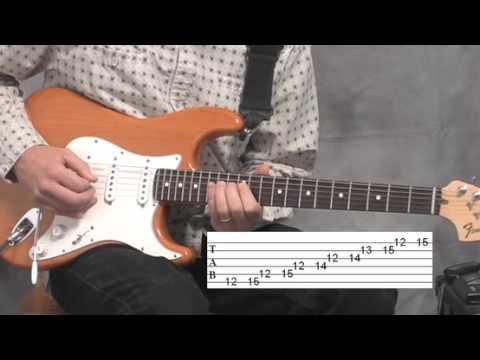
JamPlay is a very versatile product which touches up on some of the beginner techniques. As always, you can also reference the wide number of blues lessons on You Tube.
Posted in Blues, Guitar, Learn Guitar Online, Scales | 6 Comments »
Thursday, October 1st, 2009
Buddy Guy’s Legends has celebrated 20 years of incredible Blues musicians, and now that they’ve relocated just down the block (still in Chicago, of course), tickets just went on sale again! It looks like October is stacked with awesome blues already, so I’m looking forward to an awesome 21st year.
With Blues in mind, I decided to do some research and write an article on the history of blues music, and compile a free set of video blues guitar lessons. Enjoy!
-Kyle-
Posted in Blues | 1 Comment »
|